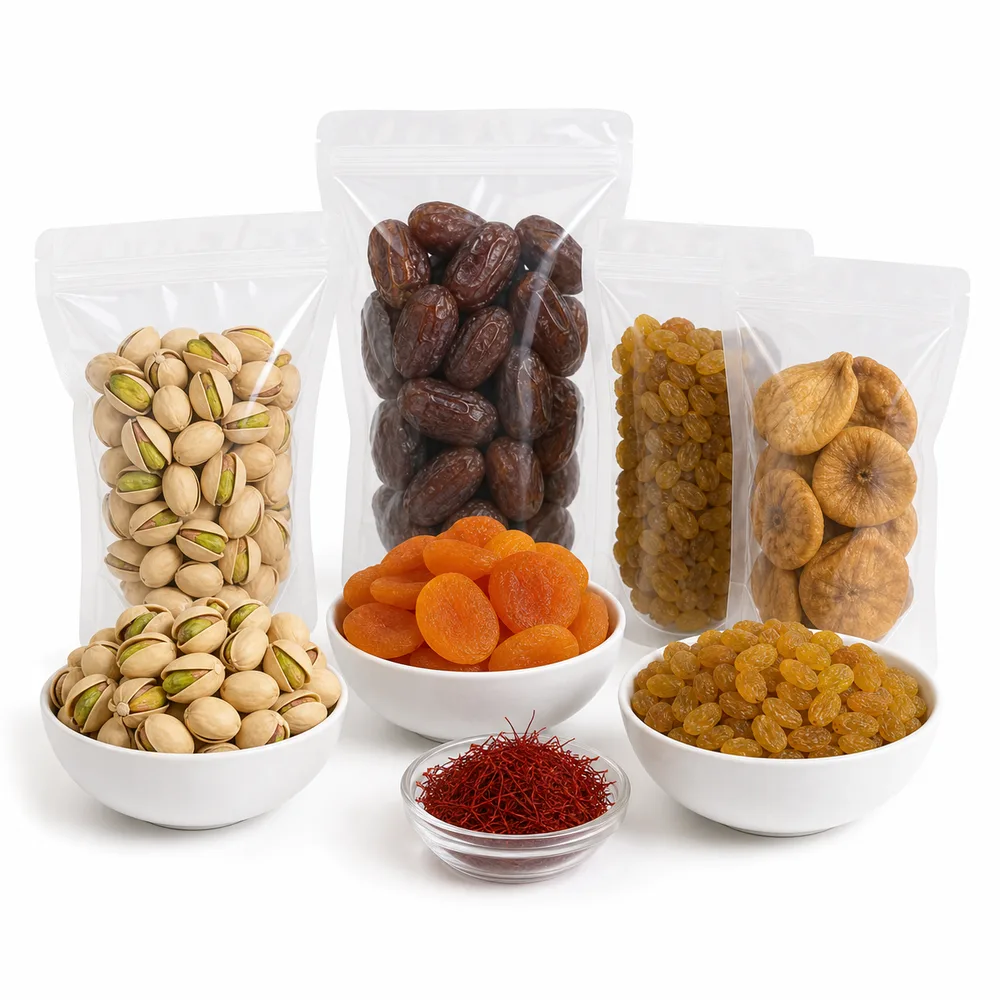
Akbari Export Pistachios: Size, Shell Opening and Pack Value
In category: Export Pistachios
Assess Akbari inshell pistachios through count-based sizing, consistency, shell opening, kernel inspection, processing choice and shipment acceptance.
Include your destination, quantity and intended use for a focused sourcing review.
Akbari buyers often value an elongated appearance and the way the nuts present in a pack. Yet a few impressive specimens on top of a sample do not establish an order's value. The Iran Pistachio Association identifies Akbari as a long cultivar; actual size, uniformity and kernel condition still require lot-specific assessment. A specialist retailer may prioritise presentation and opening experience, while a distributor also needs repeat-order consistency. This page addresses Akbari inshell pistachios for bulk and export purchasing. Availability, crop year, size, processing and supporting documents are confirmed only against a specific proposal, not assumed from the Saderati listing.
Decide when larger size creates useful value
Where the nuts remain visible in the sales pack, size can affect the customer's impression. Paying more for a larger selection makes sense only if the downstream buyer values that characteristic. In a mix or a pack with limited visibility, uniformity and kernel condition may matter more than a few exceptionally large nuts. The buying decision should connect to the selling context.
Comparing samples in the same container and at the same weight gives a fairer view. Spreading nuts widely on a tray differs from arranging them tightly in a gift container. Review the reference both loose and in the intended pack. This shows whether the appearance benefit being purchased remains meaningful in the customer's actual experience rather than only in a supplier's display photograph.
Interpret the size number with its unit
Pistachio size may be expressed as a count within a specified weight or by another stated method. With a fixed-weight count, fewer nuts means greater average weight per nut. Figures are comparable only when units and methods match. A size range without its counting basis invites disagreement. UNECE's inshell standard distinguishes sizing approaches, making the method part of the commercial description.
A satisfactory average can conceal a wide spread. A mixture of very small and very large nuts may average similarly to a uniform selection. For presentation-led retail, variation and out-of-range material therefore matter as well. Agree how that difference will be assessed before delivery. Otherwise, a numerical size claim can turn into a subjective disagreement at receipt, when the commercial expectations are already fixed.
Keep the sample selection representative. Counting only nuts chosen for a photograph says little about the population being offered and weakens an otherwise carefully defined size specification.
Separate opening, shell integrity and access to the kernel
An open shell is only one characteristic of an inshell product. Assess closed nuts, broken shells, loose fragments and visible kernel condition in the final pack. A photograph taken from the most flattering side can hide differences. Sampling across positions or packs gives a more useful picture of what the customer will receive than repeatedly inspecting the same display handful.
If the buyer has a requirement concerning how the shell was opened, include a clear supplier declaration and assessment basis. Appearance alone should not be treated as conclusive proof of a process. Opening experience belongs in the sample review but cannot replace documented specifications. A claim of excellent split is too vague to resolve a disagreement unless both parties understand how it is evaluated.
Look beyond an attractive shell
The shell is seen first, but the kernel is the consumed portion. Open a representative group during sample inspection so internal condition, filling and visible defects are considered. Where kernel-to-inshell weight matters commercially, measure it on the actual sample using an agreed procedure. The Akbari name does not create a guaranteed numerical yield for every shipment or remove the need for lot assessment.
Sensory review by responsible staff, with a defined reference and sample conditions, can contribute to comparison. Unusual odour or texture needs investigation rather than being dismissed beneath seasoning or a sales explanation. Conversely, acceptable flavour and appearance do not demonstrate every safety criterion. Sensory acceptance and the testing file should complement each other, leaving the buyer clear about the evidence supporting each decision.
Treat raw and roasted offers as different products
Raw pistachios for a buyer with a preparation process are not the same requirement as roasted nuts ready for retail. Roast profile, salt and flavourings alter the final experience and product information. Compare prices on an equivalent basis. A processed product cannot be fully described by the appearance specification of its raw input while all accompanying materials and processing information remain unstated.
When reviewing a flavoured sample, its accompanying ingredients and destination presentation belong in the purchasing file. Link trials to the intended finished form; this page proposes no universal roasting programme. Where the customer carries out further processing, keep responsibility for validating that process and finished product clear. Purchasing a named cultivar does not, by itself, resolve the downstream technical requirements.
Keep quality control broader than nut size
Aflatoxin and other destination-related requirements cannot be assessed from a photograph of large nuts. The quality team should define sampling and testing for the lot and intended use. Codex provides separate guidance for reducing aflatoxin contamination in tree nuts. That is a reference for controls across the chain, not evidence that a shipment described as export quality is automatically accepted.
Connect laboratory reports to an identifiable lot and sample. Tested is incomplete without date, reference and test scope. Certification, origin and crop-year claims also need evidence relevant to the actual offer. Acceptance limits and regulatory requirements depend on destination and product form; this page does not assign one universal number to all markets. Resolve these details before the order is released for commercial supply.
Protect the accepted presentation through delivery
For inshell pistachios, net weight, inner packaging, closure and carton count affect receipt. A final-pack sample reveals nut movement and shell condition after handling. A good result in a small sample bag does not establish the same outcome in bulk packing or a gift container. Each delivery format needs a relevant review rather than approval transferred only because the cultivar is unchanged.
Storage instructions and usable life belong to the producer's product documentation. Include any opening and subdivision after arrival in the buyer's handling plan. Batch identity should remain recoverable once the outer carton is opened. Information present only on one discarded carton is insufficient for multistage distribution, especially where the original lot is divided among different branches or customers after receipt.
Summarise the offer around the intended application
Bring together the appearance the customer wants, the acceptable product observed in the sample and the delivered cost of that specification. The most expensive size is not necessarily the best choice for every channel. Equally, a lower price with greater variation or rework may offer little benefit. The selected option should be explainable using that buyer's priorities, not a general ranking of cultivars.
A useful Saderati inquiry states Akbari inshell, sizing basis, raw or processed form, packing, quantity, destination and expected documents. A reference sample and pack-use photograph help clarify intent. Price and supply timing become meaningful after those choices are understood. No size or crop year is represented as confirmed stock solely because it appears within this general purchasing guide.
Buyer questions
Is every Akbari lot necessarily large and uniform?
Akbari is a cultivar name, not a guarantee of every nut's size. Establish size distribution and kernel condition for the specific offer. A sample containing a few display specimens is insufficient evidence for bulk acceptance.
Does a lower count always mean better quality?
At the same fixed weight, a lower count generally indicates heavier nuts. Quality includes other factors, such as consistency, condition and customer requirements. Check counting method and unit before interpreting the number or comparing two quotations.
How can a repeat order stay close to the approved sample?
Retain a clear specification version and reference. Review changes in crop year, processing and size. The repeated Akbari name is insufficient by itself. Assess each new lot against the agreed acceptance programme and relevant documents.