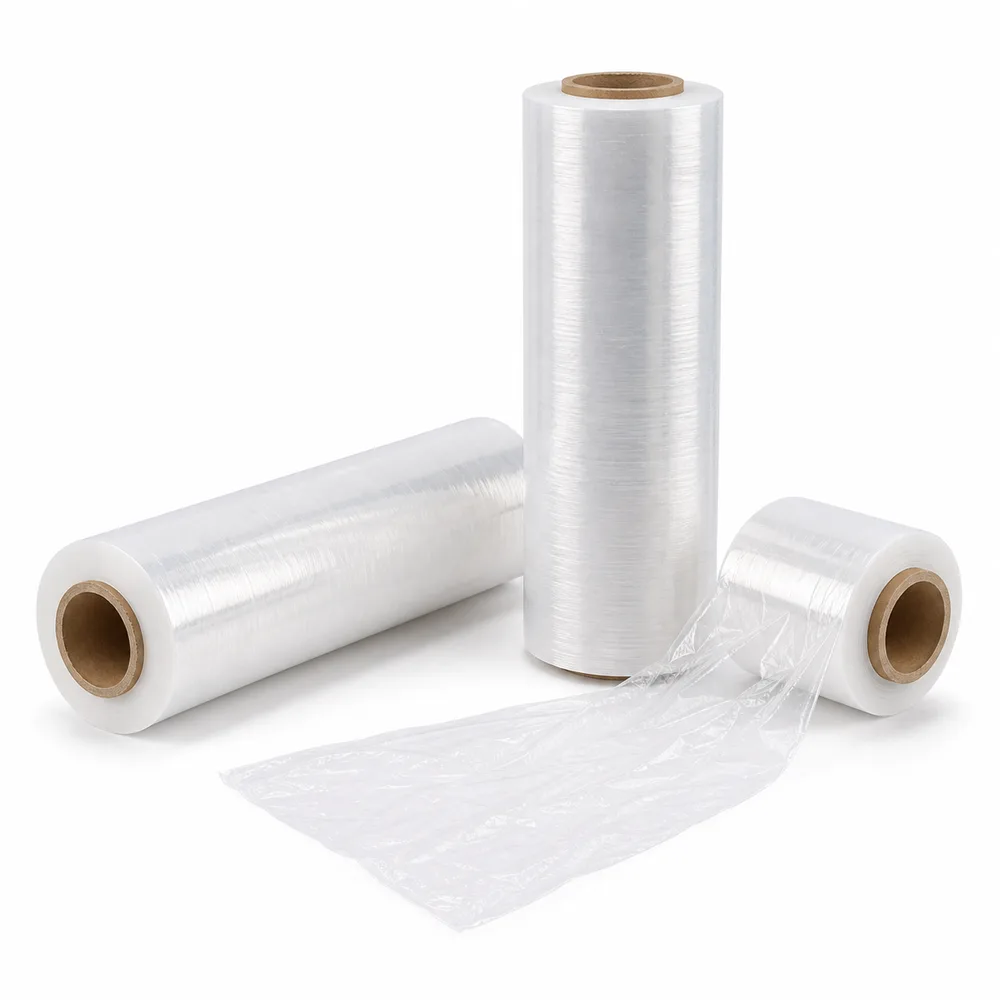
Clear Hand Stretch Film for Daily Pallet Wrapping
In category: Stretch Film
Specify clear hand stretch film for warehouse use. Evaluate roll handling, dispensers, wrapping consistency, consumption per pallet and sample acceptance before bulk buying.
Include your destination, quantity and intended use for a focused sourcing review.
PE Products in this category are usually made of polyethylene (PE, LDPE, HDPE or LLDPE) and are not PVC.
Clear hand stretch film is used to wrap loads and help keep their components together during handling. A common purchasing problem is that several warehouse operators use the same roll type but produce different results and consume different quantities. Choosing the film therefore requires attention to the dispenser, load shape and working method as well as the roll itself. This page supports enquiries for manual pallet wrapping in warehouses and distribution operations. It concerns PE load-wrapping film, not food cling film: a shared polymer name or transparent appearance does not establish suitability for direct food contact.
Describe the warehouse task before selecting the roll
A distribution centre might wrap uniform cartons in the morning and mixed customer orders later in the day. Start with approximate pallet volume, load shapes, available working space and the movement to dispatch. The description heavy-duty hand film does not communicate those differences to a supplier.
Small-bundle wrapping is also a different task from wrapping a tall pallet. Explain what needs to be held together and identify the current difficulty. Repeated corner tears, difficult unwinding and inconsistent consumption are more useful starting points than a general request for better quality.
Assess the roll together with its dispenser
A larger roll changes replacement frequency, but gross weight alone is an incomplete selection criterion. Request net film weight, core weight and compatibility with the intended dispenser separately. Confirm the core inside diameter and how the roll is supported so an installation problem is not discovered after delivery.
Ask regular users to assess the sample with the actual tool. Can they control it through the normal task? Does the dispenser manage unwind resistance as intended? Follow the tool instructions and the site's working procedures rather than improvising hand contact with moving parts to compensate for a poor fit.
Include normal operator variation in the trial
Manual wrapping depends partly on how a person controls the roll and overlaps the film. Lantech's guidance identifies fatigue and repeatability as issues in hand wrapping. A demonstration by one person at the start of a shift may therefore provide an incomplete view of everyday consumption.
Trial comparable pallets using a defined procedure and the people who normally do the work. Record time, consumption, breaks and rework. The objective is not a speed competition or maximum pulling effort; it is to understand the result achievable in a repeatable warehouse routine and identify any need for different tools or training.
Look beyond transparency to practical film behaviour
Clear film can support visual identification, but inspect the wrapped load rather than a single loose layer. Several overlapping layers can change visibility. If barcode scanning through the wrap matters, use the actual label and scanner in the trial and record whether the approved wrap pattern preserves the required readability.
Watch for edge damage, repeated tearing and difficult unwinding. Describe when and where the problem appears. A nick in one roll edge and a repeatable problem at a load corner warrant different investigation; labelling both as weak film loses information that could help resolve the issue.
Make the wrapping method understandable
Comparing films becomes difficult if each operator chooses a different starting point and guesses the required passes. Document the accepted procedure for the selected load, including overlap, treatment of the upper and lower sections and finishing the film tail. Align that procedure with equipment guidance and your packaging assessment.
A universal wrap count is not appropriate for every load. A tall mixed pallet presents different demands from a regular stack of identical cartons. Establish the required finished-load result with the responsible packaging team, then evaluate candidate films against it. A tight-looking surface alone is not a measurement of load performance.
Separate roll price from cost per accepted pallet
For a useful cost comparison, measure film consumed over a defined group of similar pallets. Include film discarded during breaks or roll starting. A lower-priced roll may contain a different net quantity or produce fewer acceptable loads, so the initial price does not explain the operational cost by itself.
Keep replacement time and rework separate so the reasons for any difference remain visible. Limit the conclusion to the load types and conditions tested; consumption on a short regular pallet should not be projected across all warehouse output without evidence. The buying decision needs both a cost basis and an acceptance basis.
Clarify whether the offer is conventional or pre-stretched
Suppliers may propose conventional hand film or a pre-stretched option. Identify that distinction explicitly rather than expecting identical behaviour during application. Dow separates these types in its overview of manual films. Ask the supplier to describe the offered format and the intended handling method.
If changing the roll type, explain the difference to trial users and follow the relevant instructions. Testing solely through an old habit can produce a misleading comparison. Treat any stated material saving as something to verify in your own operation rather than a guaranteed result of purchasing the new roll.
Protect roll condition before it reaches the user
Check edges, cores and wrapping when the goods arrive. A roll damaged during transport may need investigation before it is issued to an operator. Record photographs and the package reference at receiving so the likely timing and location of damage can be examined later.
Obtain the supplier's storage and use guidance and compare it with your warehouse conditions. Keep damaged rolls identifiable and separate from accepted stock. Unrecorded movement between work areas makes recurring problems harder to trace; a simple carton and batch reference gives later observations a useful connection to the supplied material.
Create a specification that supports repeat orders
Record width, declared thickness, net quantity, core details, carton count and the agreed receiving method. Where the offer gives a range, do not silently convert it into a single guaranteed value. Link the accepted sample and proposed product code to the purchase specification.
Retain that reference for subsequent deliveries. A change in film format or packaging should not be accepted solely on an informal assurance that it is equivalent. Ask the supplier to identify changes relevant to use before dispatch so a further trial can be arranged where the change warrants one.
Prepare a focused hand-film enquiry
Send a short account of the warehouse task and the current problem alongside any known dimensions. Where a final thickness or roll quantity is still undecided, identify the open field and request a proposal with a trial method. Saderati uses the brief to review the enquiry and facilitate a relevant supplier connection; availability and price require a response.
- Load dimensions, shape, approximate pallet volume and handling route.
- Dispenser type, core requirements, film width and desired net quantity.
- Conventional or pre-stretched format and a specific current-use difficulty.
- Order quantity, destination, packing and sample acceptance criteria.
Buyer questions
Can hand film be installed on any pallet wrapper?
Do not infer compatibility from the roll's appearance. Film behaviour, core dimensions and machine requirements need assessment. For equipment use, submit a machine-film enquiry with the wrapper details.
Does thicker film always reduce consumption?
No. Consumption depends on the film, method and load. Compare candidates on similar pallets with the same acceptance criteria to establish cost per acceptable wrapped load.
Why can two operators obtain different results?
Roll control and wrap pattern vary in manual application. Include tools, methods and normal users in the sample review; a difference is not automatically a film defect.
Is this film intended for direct food contact?
This page covers manual load and pallet wrapping. For food covering, use the food-cling category and a product documented for the intended contact conditions.