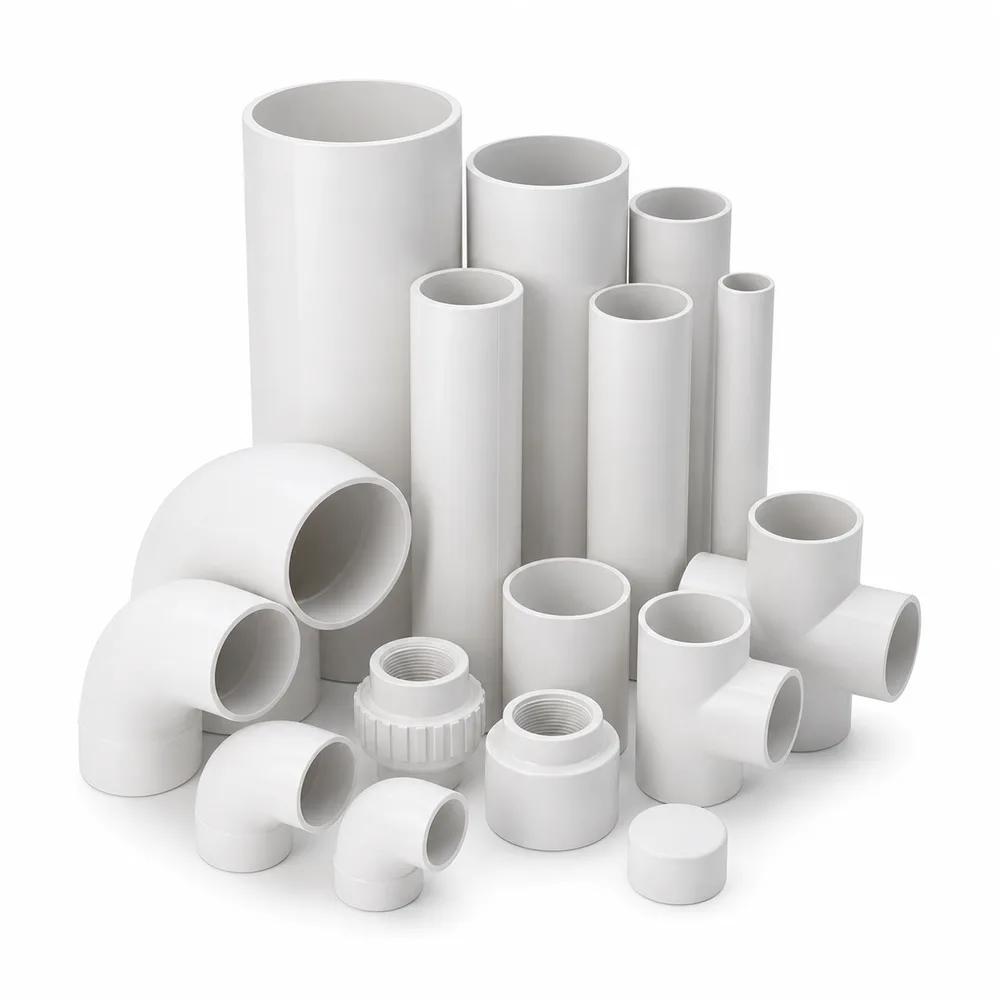
PVC Elbows and Tees
In category: PVC Fittings
Specify PVC elbows and tees by angle, port dimensions, joint arrangement and service. Compare alternatives, review samples and receive clearly identified fitting quantities.
Include your destination, quantity and intended use for a focused sourcing review.
PVC These products are made of PVC (polyvinyl chloride).
Elbows and tees often occupy short lines in a purchasing schedule, yet they determine where a pipe network turns and branches. If the angle, installed length or branch size is wrong, a warehouse full of straight pipe will not solve the problem. A fitting order therefore needs more than a familiar name and a quantity. This guide helps buyers connect PVC direction changes and branches to drawings, mating components and the real needs of the project. Final selection must refer to an identifiable product and technical acceptance. The general illustration on this page does not establish the dimensions or suitability of every proposed option.
Describe the actual shape and every connection
For an elbow, identify the required angle and both end arrangements. For a tee, distinguish the two run ports from the branch. If sizes differ, add a small labelled sketch. A sequence of sizes without a reference drawing may be interpreted differently by two sellers, creating quotations that appear comparable while describing different components. Resolve the sequence before quantities are confirmed.
Connect local market names to a manufacturer reference or drawing. Terms such as reducing tee or short elbow can start a conversation, but they are not a complete purchasing definition. Ask the bidder to confirm the full product identity, connection method and geometry. A precise description also gives the receiving team something objective to recognise when cartons arrive.
Keep pressure and drainage selections distinct
Establish the line's service before choosing a fitting shape. Pressure networks and building drainage routes can both contain parts called elbows and tees, but that common terminology does not make the products interchangeable. The project specification should identify the acceptable system and the evidence required for any proposed change. Purchasing staff should not have to infer application suitability from appearance.
Charlotte Pipe presents PVC pressure products as a defined system. For a buyer considering a generic listing, the relevant lesson is to read the actual offered product data rather than relying on the material name. State drinking-water, process-fluid or other special requirements separately. Approval associated with one manufacturer's product must not be transferred to every item discussed on this page.
Review the installed envelope as well as size
In a confined location, the question is not simply whether a pipe fits into a socket. Overall length, centre-to-end dimensions and the space required by adjoining equipment also matter. Place the proposed fitting drawing beside the installation layout. Identify sensitive locations near walls, valves or equipment so they receive attention before a large quantity is purchased and delivered.
GF publishes individual dimensions and references for elbows and tees in its product range. This illustrates why two nominally similar fittings need not occupy the same installation envelope. When a supplier changes the proposed brand or reference, recheck the dimensional difference. A substitution in a purchasing spreadsheet should not silently move a pipeline or change an equipment connection.
Treat altered routing as a design decision
When a requested component is unavailable, a seller may propose replacing it with several other fittings. That arrangement can change the route, the number of joints, maintenance access and network performance. Procurement can collect the alternative, but its acceptance belongs to the technical reviewer. A lower price or earlier availability does not by itself establish that the change is suitable.
For tees, describe the purpose of the branch and the equipment that follows it. A branch serving a maintainable device presents different access questions from a fixed connection. If the drawing imposes a particular arrangement or flow-related requirement, include its reference in the enquiry. Do not expect a catalogue photograph to establish the correct orientation for a specific project.
Make the joint arrangement explicit
The ends of an elbow, or the three ports of a tee, are not necessarily identical in their connection method. Identify which are sockets, threads or another arrangement, and what will connect to each. Mixed-end fittings need a clear reference on both sides. Agreement on nominal size is not a substitute for confirming that the complete mating interface is appropriate.
Request the relevant installation information and associated consumables for the offered product. For solvent-jointed components, material selection and site conditions must follow the applicable system and consumable instructions. This page does not prescribe cure periods, turns or application quantities. Qualified installation under the approved procedure is essential; the purchasing task is to ensure the necessary information is available beforehand.
Use a sample to answer a defined question
When a fitting must occupy a sensitive space, explain what the sample should establish: port location, wall clearance, mating-component compatibility or readable identification. A photograph linking the sample to its reference and a scale can help later discussions. A loose sample with no confirmed model identity is a weak basis for ordering a large batch of apparently similar products.
Visual review is not a performance test or pressure approval. If the project requires a test or a particular document, let the technical owner define the method and acceptance criteria. Record the sample decision briefly and refer later changes back to it. State which features were examined, what was accepted and which questions still need a separate decision.
Prevent similar parts from becoming mixed stock
Closely related elbows and tees can be difficult to distinguish in a mixed delivery. Request labels showing the product reference, port sizes and a countable quantity. If the sales unit is a carton, confirm its contents and how the ordered total is calculated. Total shipment weight does not demonstrate that the correct number of every individual fitting has been supplied.
On receipt, reconcile labels with the packing list and examine the visible condition of sockets, edges and other relevant surfaces. Keep uncertain items separate for a decision by the designated reviewer. A discrepancy record should name the fitting and the quantity affected. For phased work, identify packages by the installation area so allocation and consumption remain traceable.
Build an enquiry with one clear row per part
Send Saderati the destination, network service and drawing reference alongside the fitting schedule. Each row should identify the shape, angle, all port dimensions, joint arrangement, preferred reference if known and required quantity. Add drawings or installation limits for space-sensitive parts. The bidder should learn about those restrictions before selecting a product, not after preparing a price for something that cannot fit.
Ask for alternatives in separate rows with the differences explained. Clarify complementary items, packaging and delivery terms as part of the comparison. Saderati's role is to facilitate contact around a clear requirement. The existence of this page does not confirm stock, a pressure class or certification for an unspecified item. Final acceptance rests on the actual proposal and project needs.
Buyer questions
Can all elbows with the same nominal size replace one another?
No. Angle, installed dimensions, port arrangement, dimensional system and intended service may differ. Check the particular reference against the layout and mating components, especially in restricted spaces.
How should a reducing tee be described?
Label the run ports and branch on a sketch and assign each its required size. Ask the supplier to confirm that same order of dimensions in the proposed item.
Does a sample fitting onto the pipe prove suitability?
It may answer only one fit question. Service suitability, joint requirements and project acceptance still depend on the relevant documentation and technical review.
What if the original fitting cannot be offered?
Obtain the alternative reference and drawing, then submit the differences for review. Do not turn an unapproved combination of components into a final purchase simply because it is available.