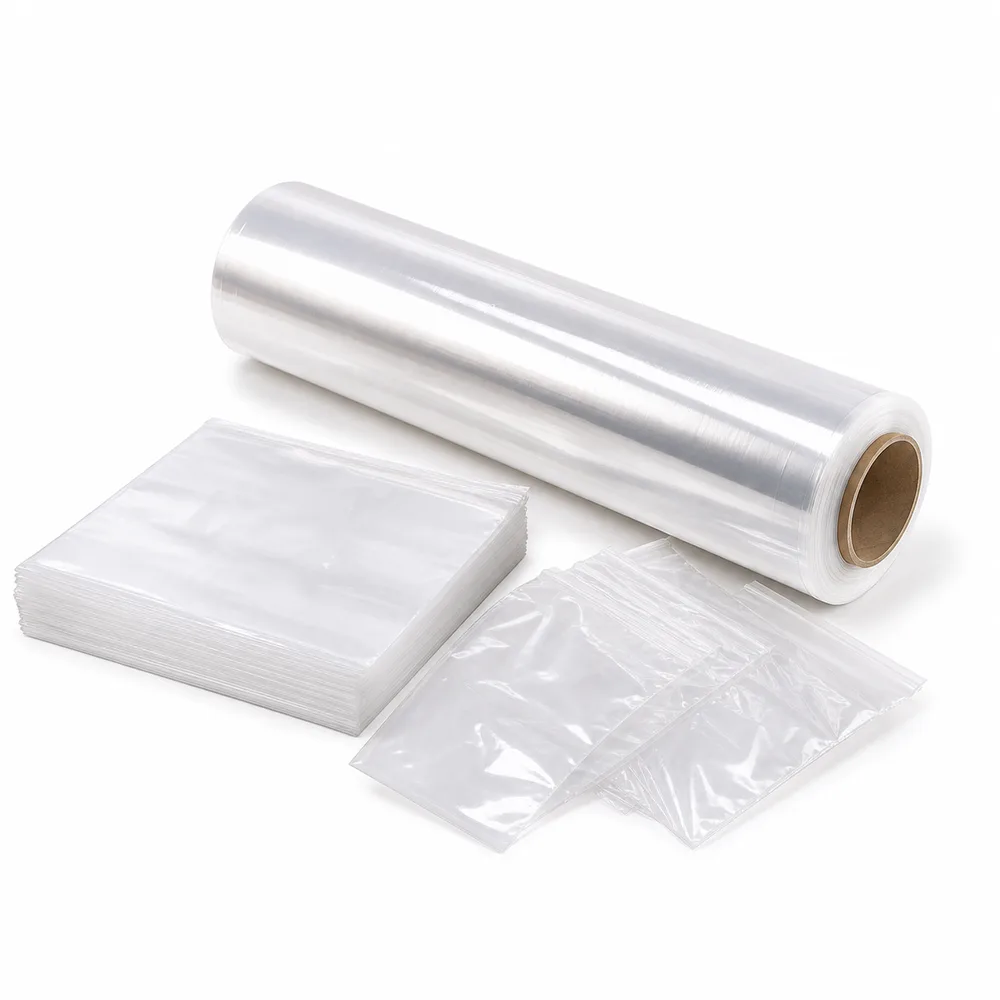
Clear Industrial PE Film
In category: Nylon Packaging Film
Select clear PE film for industrial part covering with identification, surface compatibility, removal and specialist protection boundaries in view.
Include your destination, quantity and intended use for a focused sourcing review.
PE Products in this category are usually made of polyethylene (PE, LDPE, HDPE or LLDPE) and are not PVC.
Clear industrial polyethylene film is relevant when a component needs a cover while its identity or status remains visible. An assembled part waiting for its next operation, for example, should not need complete unwrapping every time someone identifies its model. In this catalogue group, the Persian trade term nylon means PE film; it is not technical nylon or polyamide. This guide focuses on general component covering within an industrial workflow. Corrosion inhibition, scratch protection, electrostatic protection and adhesion to a surface are separate capabilities, none of which is established by transparency alone.
Define the cover's role between operations
Start with the point where film is applied and the point where it is removed. The objective may be separating a part from incidental contact during temporary storage or keeping an assembly orderly until final inspection. Do not confuse that task with final shipment packaging. If the part is later restrained in a crate, the temporary cover is one stage of the process, not a replacement for every protective element.
Each handover owner should understand what the cover signifies. Transparent film must not automatically be interpreted as quality approval unless the organisation explicitly defines it that way. Manage part identity and production or inspection status separately. This prevents a covered but incomplete component from being treated as ready for dispatch and gives the next operator a clear basis for deciding what happens next.
Make visibility serve a specific inspection task
State what must be read through the film: a part code, status label, surface colour or a particular area. If the covering overlaps, evaluate that actual arrangement. A single layer on a desk does not represent a folded cover. Label location and the wrapping path may improve daily identification without changing the material at all, so include both in the sample review.
Seeing the component through film does not replace every quality check. Some surface observations require removing the cover and using appropriate viewing conditions. The work instruction should distinguish checks allowed through the covering from those requiring access. That boundary prevents convenient identification from becoming an incomplete final inspection, especially when a clear view of the label is mistaken for a clear view of all surfaces.
Distinguish loose covering from adhesive protection film
Film placed around a component does not necessarily adhere to its surface. If a protective layer must stay attached to a sheet or panel and later be removed in a controlled way, the requirement may be for a specialist surface-protection construction. Novacel addresses such films in relation to surfaces and processes. A transparent general-purpose PE cover should not be presented as equivalent simply because it looks similar.
Specify whether you need loose film, a fabricated cover or adhesive protection. If tape or a tie will retain the cover, consider its contact location in the design too. Film selection and retention method are connected decisions. A cover that remains in position during stationary storage may move when the component is transferred, which can require a revised package arrangement rather than a different film alone.
Evaluate compatibility over the relevant contact period
For painted, glossy or specially finished components, a generic material name is insufficient. Evaluate the proposed film on the actual surface and inspect that surface after removal. Include relevant contact time, pressure from stacking and storage conditions in the plan. A brief contact in a sample room does not represent every production-storage condition, particularly when approval will later be applied to a longer waiting stage.
If staining, appearance change or a contact mark occurs, keep linked film and component samples and review the observation with the material and finish owners. Do not introduce an arbitrary cleaner or chemical change to hide the mark. The cause can involve the surface, its readiness for covering or the packing operation. Evidence is needed before attributing every observed effect to the film.
Keep general covering separate from specialist protection
Corrosion-inhibiting film is not another name for transparent film. Cortec, for example, describes VCI products using a corrosion-inhibitor technology; that function belongs to an identified construction. The same distinction applies to electrostatic or specialist scratch protection. If the real problem is rust, circuit damage or preservation of a sensitive finish, state it directly so that a general cover is not selected as an unsupported substitute.
Covering a part also does not restrain it for transport. Supports, separators, outer packaging and load securing need their own assessment. The term industrial does not authorise use around hot components, operating machinery or incompatible substances. Follow equipment instructions and the responsible technical review for those conditions. This page assigns no invented safety limits or resistance claims to an unspecified film.
Design removal as part of the covering process
The next operator should know where to begin opening and how to remove the cover without damaging the component. If the design forces a cutting tool close to a sensitive surface, review the opening approach. Access and closure position should suit the process. A cover that is quick to apply but difficult to remove may simply transfer labour and risk from one station to another.
Keep removed covering and new film distinguishable in the workflow. If reuse is intended, define when it is permitted; intact appearance alone does not prove cleanliness or retained performance. A collection point and clear material identification also support orderly operations. Any recycling statement should correspond to the actual waste-management route rather than assuming that every used industrial film enters an available recycling stream.
Test one complete component journey
A useful trial includes application, waiting, permitted transfer, identification and removal. Record preparation and opening effort, waste and any surface observations. Where the cover serves several component types, assess the more demanding geometries separately. Approval on a smooth part should not automatically extend to a different part with projecting edges simply because both are produced by the same factory.
For a Saderati enquiry, send component photographs, surface identity and condition, covering function, contact duration, film form, dimensions, retention method and identification needs. The response should identify the material and confirmed limitations. Compare cost per acceptable covering and work effort, not just roll weight. Link the reference sample and specification to the order so that material or application changes remain traceable.
Buyer questions
Is this an adhesive surface-protection film?
Not necessarily. This page concerns general PE covering. Controlled adhesion and removal require a specialist protection film assessed for the specific surface and process, rather than an assumption based on appearance.
Can final component quality be approved through the film?
Only for checks explicitly defined as suitable for that condition. Transparency can aid identification, but not every surface or dimensional issue can be evaluated through a cover.
Does a transparent cover prevent corrosion?
Transparency does not establish that function. Define corrosion protection separately and qualify the packaging system. Do not equate general film with a documented VCI or other preservation solution.
Why inspect the surface after removing the cover?
Some compatibility observations emerge only after contact and removal. Recording surface condition, contact time and trial circumstances helps distinguish film-related effects from prior surface issues or handling problems.